Most of us think of aging in familiar terms — fine lines, a slower metabolism, shifting hormones, recovery that takes longer than it used to. We rarely think of digestion. Yet some of the most influential aging signals in the body begin in the gut.
In a functional medicine setting, gut health is often the starting point — not because every symptom traces back to digestion, but because the gut quietly shapes inflammation, hormone metabolism, immune resilience, and energy. For patients across Addison, North Dallas, Plano, and Frisco, addressing the gut is often the foundation of a longevity-focused plan.
Quick Answer
Yes — gut health can meaningfully influence how you age. The microbiome helps regulate inflammation, hormone metabolism, nutrient absorption, and immune function, all of which shape healthspan. When the gut is supported, energy, recovery, hormones, and resilience tend to follow.
What Does Your Gut Have To Do With Healthy Aging?
The gut sits at the center of several systems that drive how we age. It absorbs the nutrients our cells need, helps regulate immune activity, modulates inflammation, supports hormone metabolism, communicates with the brain, and influences how the body uses fuel.
- Nutrient absorption — protein, iron, B12, magnesium, and fat-soluble vitamins all depend on a functioning gut
- Immune regulation — roughly 70% of immune tissue lines the digestive tract
- Inflammation control — a healthy gut barrier keeps the immune system calm
- Hormone metabolism — the gut helps clear estrogen and supports thyroid conversion
- Brain-gut connection — gut signals influence mood, focus, and sleep
- Metabolic health — the microbiome plays a role in blood sugar and weight regulation
Many symptoms people blame on aging — fatigue, brain fog, slower metabolism, joint stiffness, weight-loss resistance, mood changes — may be partly rooted in gut function rather than time itself.
The Gut–Inflammation Connection
Chronic, low-grade inflammation is one of the most discussed drivers of biological aging — sometimes called inflammaging. It rarely produces obvious symptoms early on, but over time it can affect energy, recovery, cardiovascular health, cognition, and skin quality.
The gut lining acts as a selective barrier. When that barrier becomes irritated or more permeable than it should be — a pattern sometimes referred to educationally as "leaky gut" — the immune system can become persistently activated, contributing to background inflammation throughout the body.
This is one reason a functional medicine evaluation often begins with the gut. Addressing barrier integrity, microbiome balance, and digestive function can quiet immune signaling and meaningfully shift how the body feels and ages.
Why Gut Health Matters for Hormones
Hormones don't operate in isolation — they're produced, transported, used, and cleared, and the gut influences nearly every step. Patients pursuing hormone optimization often see better results when gut health is addressed alongside.
- Estrogen metabolism — a specialized group of gut microbes (the "estrobolome") helps regulate how estrogen is cleared
- Thyroid support — much of the conversion of inactive thyroid hormone (T4) to its active form (T3) involves the gut
- Cortisol & stress response — the gut-brain axis influences how the body reacts to chronic stress
- Blood sugar regulation — gut bacteria influence insulin sensitivity and post-meal glucose
- Nutrient absorption — hormones need the building blocks (protein, minerals, B-vitamins) that the gut delivers
When digestion or microbiome balance is off, even well-designed hormone protocols can underperform. Supporting the gut often helps hormone optimization efforts work the way they're meant to.
The Microbiome and Longevity
The microbiome — the community of trillions of bacteria, fungi, and other microbes living in the digestive tract — is increasingly studied as a longevity factor. Emerging research suggests that microbial diversity tends to correlate with metabolic flexibility, immune resilience, and healthier aging.
- Diverse microbial communities tend to be more adaptable and resilient
- Specific bacteria help produce short-chain fatty acids that support metabolism and the gut barrier
- Microbial balance influences how the immune system recognizes and responds to stress
- Longevity researchers continue to study links between the microbiome and biological aging markers
This is why functional medicine treats the microbiome as part of whole-body health, not a niche concern. It's foundational infrastructure — and infrastructure ages well when it's supported.
How Functional Medicine Evaluates Gut Health
Evaluation begins long before any test is ordered. A thorough history often reveals patterns — symptoms that come and go, food responses, sleep changes, stress windows, prior antibiotic use — that point toward where to look first.
- Comprehensive health history — symptom timeline, medications, prior illnesses, stressors
- Lifestyle assessment — sleep, movement, stress management, alcohol
- Nutrition review — patterns, intolerances, fiber and protein intake
- Functional testing — when clinically indicated, to clarify the picture
Two of the most commonly used functional tests in this setting are:
- GI-MAP comprehensive stool testing — assesses pathogens, opportunistic bacteria, beneficial flora, digestion markers, and inflammation indicators
- MRT food sensitivity testing — identifies foods and chemicals that may be triggering inflammation
Testing recommendations vary based on symptoms, history, and goals. The point isn't to test everything — it's to gather the information that meaningfully changes the plan. Learn more about our overall approach on the functional medicine and gut health & longevity pages.
Longevity Medicine Is About More Than Living Longer
Longevity medicine isn't about extending years for their own sake. It's about extending healthspan — the years lived with energy, cognitive clarity, mobility, and resilience.
- Energy that lasts through the day without crashes
- Recovery from workouts, travel, and stress that doesn't take a week
- Cognitive performance — focus, memory, mental clarity
- Resilience — how the body handles illness, stress, and change
- Prevention — identifying drivers before they become diagnoses
Gut health is a foundational piece of that framework. So is hormone optimization, metabolic health, sleep, movement, and — when appropriate — targeted support such as peptide therapy. Together, these systems make up the longevity-focused care model at Unscripted Medicine.
The Gut-Collagen Connection
Many patients associate collagen with skin health and appearance, but collagen production begins with the body’s ability to properly digest, absorb, and utilize nutrients.
The digestive system plays a critical role in breaking down proteins into amino acids, which serve as building blocks for collagen production. Nutrients such as vitamin C, zinc, and amino acids must be adequately absorbed to support healthy collagen synthesis.
When digestive function is impaired, nutrient absorption may be affected. Supporting gut health can help create an environment that promotes healthy collagen production, tissue repair, skin quality, and overall healthy aging.
At Unscripted Medicine, we recognize that healthy aging extends beyond cosmetic treatments alone. Internal health and external appearance often work together.
Could Your Gut Be Affecting How You Feel Today?
Many patients arrive having normalized symptoms they've lived with for years. If any of the following sound familiar, the gut may be worth a closer look:
- Bloating, gas, or discomfort after meals
- Brain fog or trouble concentrating
- Persistent fatigue that doesn't improve with sleep
- Food sensitivities or reactions that seem to be expanding
- Hormone-related concerns — cycle changes, low energy, mood shifts
- Weight-loss resistance despite consistent effort
These symptoms aren't proof of a gut issue — but they're often a signal worth investigating in a functional medicine setting.
Frequently Asked Questions About Gut Health and Aging
Gut Health Is One Piece of Longevity Medicine
At Unscripted Medicine, we view gut health as one of the foundational pillars of longevity medicine. A healthy gut influences nutrient absorption, inflammation levels, immune function, hormone balance, metabolism, and overall wellness. While improving digestive health is important, true healthy aging requires a broader strategy.
Longevity medicine focuses on optimizing healthspan by addressing multiple interconnected systems. Gut health works alongside hormone optimization, metabolic health, healthy body composition, strength training, nutrition, recovery, and lifestyle factors to support long-term vitality.
By identifying and addressing underlying imbalances, patients can develop a personalized plan that supports feeling better, functioning better, and aging better over time.
Begin Your Gut Health & Longevity Journey
Functional medicine looks at how you feel today — and how you want to feel five, ten, and twenty years from now. If gut health, hormones, energy, or longevity are on your mind, a consultation is a thoughtful first step.
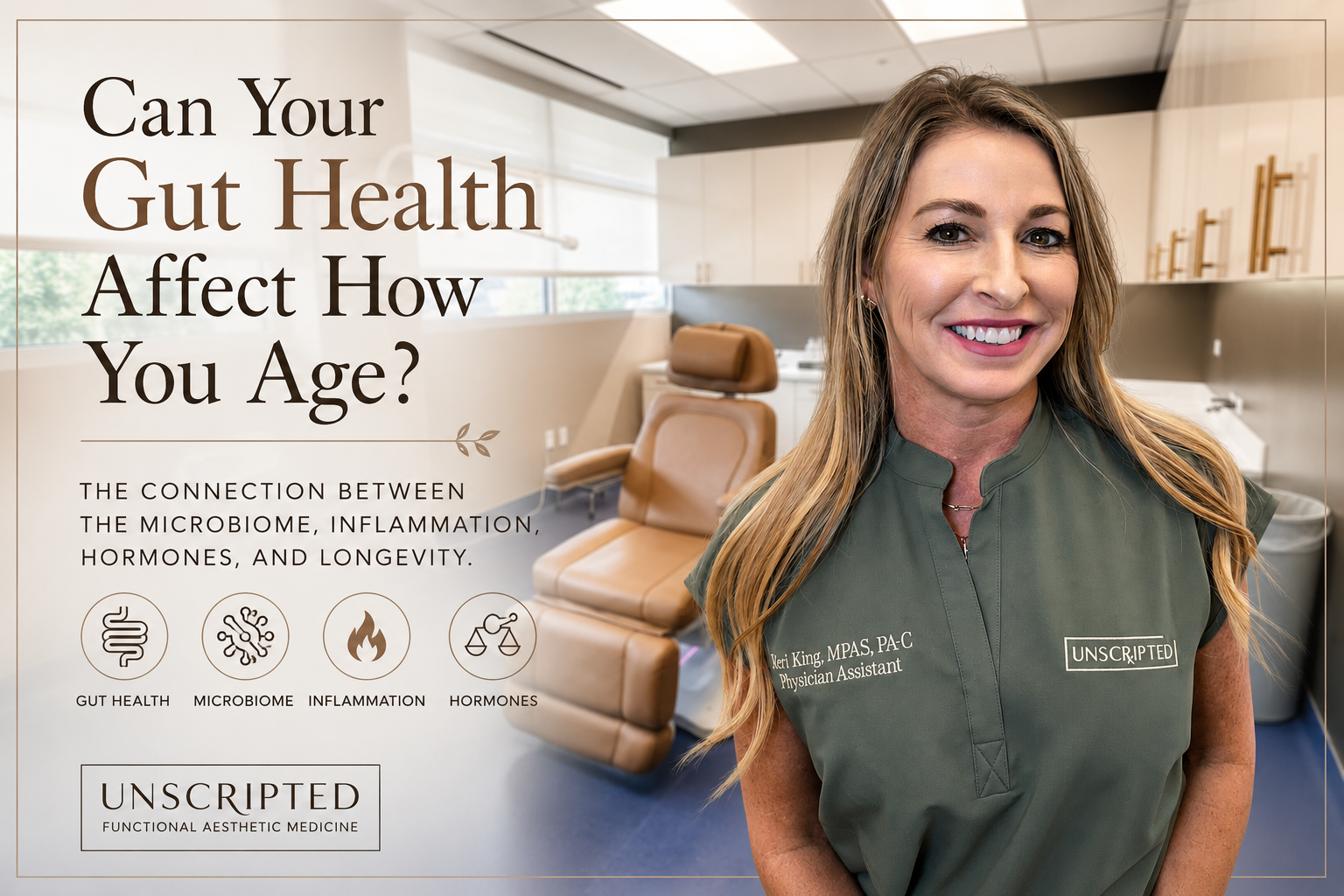
Functional gut health services at Unscripted Medicine are guided by Keri King, MPAS, PA-C, who has completed advanced training through the Institute of Restorative Health.
Care provided by Keri King, MPAS, PA-C — serving Addison, North Dallas, Plano, and Frisco.